Convicts, punishment, and social stigma
Great ExpectationsConvicts, punishment, and social stigma is a recurring framework through which the novel connects crime, legal punishment, social exclusion, and moral responsibility. Its prison ships are first presented to Pip as a nearby, terrifying destination for wrongdoers; later, the legal consequences of escape and unauthorized return shape Abel Magwitch’s life, wealth, and final days. The contrast between official condemnation and the compassion shown by Joe Gargery, and eventually by Pip, makes the convict’s legal status an incomplete measure of his character.
The Hulks in a Child’s Imagination
When Pip asks where the distant gunfire comes from, Mrs. Joe Gargery tells him it comes from the Hulks: prison ships across the marshes. She explains that people are sent there for murder, robbery, forgery, and other crimes, and rebukes Pip for asking one question after another. Her explanation turns the ships into a ready threat in his mind. Already terrified by the escaped convict he has encountered, and burdened by a promise made under fear, Pip imagines that his questions and planned theft from the pantry put him on a path to the same punishment.
The retrospective narrator emphasizes the secrecy fear imposes on children: Pip is afraid of the man who threatened him, of the convict he met, and of himself because of the promise extracted from him. In his imagination, the river carries him toward the prison ships and the gallows. This childhood association makes the penal system more than a distant institution: it becomes part of the private logic by which Pip interprets guilt, danger, and even ordinary acts of disobedience.
Capture and the Prison-Ship System
When soldiers pursue two escaped convicts on the marshes, the search ends with both men captured after a struggle. Magwitch insists that he found the other convict, stopped him from getting away, and brought him back; the second man, Compeyson, alleges that Magwitch tried to murder him. The opposing accounts establish their conflict without resolving it at the scene. The officers separate the prisoners and escort them under guard toward the river.
At a rough hut and landing place, the soldiers record the proceedings, and Compeyson is taken to the boat first. Magwitch then acknowledges that he stole food from the blacksmith’s home, where Joe confirms that a pie has gone missing. Joe does not know what Magwitch has done, but says he would not have wanted him to starve. The exchange places a basic act of mercy beside the machinery of arrest: Joe recognizes a hungry human being where the legal process recognizes a prisoner.
Magwitch is put aboard a boat rowed by convicts and taken to the black prison ship moored offshore. Its barred construction and heavy chains make the vessel appear continuous with the restraints imposed on its occupants. As the boat departs, the torches are extinguished. The scene’s finality reinforces the distance between the shore and those sent back into custody, even as Joe’s response refuses to reduce the man to his crimes.
Stigma, Recognition, and Moral Obligation
The convict identity continues to mark Magwitch after his return from transportation. During a later visit to Joe’s public house, a stranger stirs and tastes his drink with a file, concealing the object from everyone but Pip. Pip recognizes it as Joe’s file and understands that the stranger knows the convict he met on the marshes. Recognition is conveyed through an object associated with the earlier encounter, linking Magwitch’s secret past to the ordinary life from which Pip has tried to distance himself.
Magwitch’s former companion later recounts how Magwitch asked him, on the point of discharge, to find the boy who had fed him and kept his secret, and give Pip two one-pound notes. The gift makes gratitude tangible, but it also binds Pip’s childhood action to the adult consequences of Magwitch’s penal history. Magwitch has not forgotten the boy’s help; his attempt to repay it will become part of the concealed origin of Pip’s expectations.
Exile, Return, and the Law
Magwitch explains to Pip that his sentence was for life and that returning to England means death under the law. He has nonetheless come back, saying that he intends to stay and that he would have made the journey even if the danger had been far greater. His return is therefore both a personal act—an attempt to see Pip—and a renewed legal offense. The wealth he has accumulated overseas cannot free him from the status attached to his sentence.
Mr. Jaggers later confirms that he had warned Magwitch in New South Wales that he was exiled for life, unlikely to receive a pardon, and liable to the law’s extreme penalty if he presented himself in England. Jaggers stresses that he maintained a strict line of fact in his dealings with Pip. The legal warning helps explain why Magwitch’s benefaction had to remain concealed and why his return transforms a private relationship into a matter of criminal exposure.
The danger is not merely abstract. Magwitch tells Pip that there are few people likely to identify him and that he will not advertise his return under his own name, yet insists that he came regardless. Later, Orlick reveals that Compeyson’s side has learned Magwitch’s identity and warns of the danger to him. The convict label thus depends on both formal law and the threat of recognition: concealment may delay capture, but it cannot erase the consequences of returning.
Trial, Forfeiture, and the Meaning of Punishment
After Magwitch is captured, the case cannot proceed immediately because an officer from the prison ship he had escaped must establish his identity. Although no one doubts who he is, the required witness is unavailable in London. Mr. Jaggers tells Pip that once the witness appears, the case will be decided quickly and against them. The delay exposes a system in which identity must be legally proved even when it is commonly believed, while the likely outcome is treated as nearly certain.
The law also threatens Magwitch’s property with forfeiture. Pip learns that he has no recognized claim to the money or land Magwitch expected him to inherit: there was no valid settlement in Pip’s favor before the apprehension, and an arrangement made afterward would be useless. The notes found on Compeyson after his death suggest that he hoped to benefit from the forfeiture and had obtained information about Magwitch’s assets. Magwitch, unaware that the inheritance was lost, continues to believe that it is secure. His ignorance spares him the knowledge that the wealth meant for Pip cannot achieve its purpose.
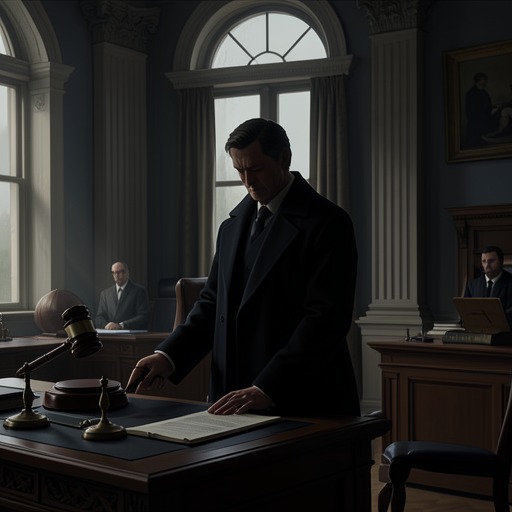
At the sentencing session, Magwitch is among thirty-two men and women brought before the judge. The court’s account traces his repeated offenses, imprisonments, earlier sentence of exile, escape, and later return to the country that had banished him. It also acknowledges that he appeared to have lived peacefully and honestly overseas before returning. The judge presents that return, followed by his capture while fleeing and the death of his denouncer, as the aggravated case for which the prescribed punishment is death. The sentence places individual history inside a public judicial ritual, where the prisoner is one among many condemned people and the crowd watches as an audience.
The novel does not make the legal judgment disappear, but it places it alongside Magwitch’s generosity to Pip, Joe’s willingness to feed him, and Pip’s efforts to care for him. That contrast makes punishment and stigma consequential without making them morally definitive: the law can classify, confine, exile, and confiscate, but the human relationships formed across those boundaries complicate the meaning of the label convict.